
The science
222 nanometers.
Far-UVC is absorbed by protein within a few micrometers. That depth is larger than a bacterium or a virus, and smaller than the dead outer layer of human skin. The whole approach rests on that difference in scale.
200–235 nmFar-UVC band
5–20 µmStratum corneum, dead cells
<1 µmTypical bacterium or virus
01Spectrum
A different part of the ultraviolet.
Germicidal lamps have used 254 nm for decades. It reaches living cells in skin and the eye, so it is restricted to empty rooms. Filtered 222 nm sources emit a narrow peak inside the Far-UVC band.
Relative emission · 200–400 nmWhere 222 nm sits
222 nm Far-UVC254 nm conventional
Move across the chart to read wavelength and band.Far-UVC is the 200–235 nm band. Lifelight emits a narrow peak at 222 nm.
02Safety
It comes down to depth.
Protein absorbs 222 nm so strongly that the light is spent within the stratum corneum, a layer of dead, keratin-filled cells 5 to 20 µm thick. Microbes are smaller than that depth. 254 nm travels further and reaches living cells.
How deep the light goes · not to scaleHow deep the light goes · not to scale
Thickness and size ranges from Buonanno et al., Radiation Research 2017.
03Efficacy
How much light it takes, and on what.
Published 222 nm results on one scale. Airborne viruses are the most sensitive, microbes on surfaces need more, and results on skin are lower again. Every effective dose sits below the exposure limits.
Light needed for each resultLight needed for each result
Airborne, fittedViruses, surfacesBacteria and spores, surfacesHuman hands
Each dot shows how much 222 nm light produced a published result. Further left means less light was needed. Every result sits well below the exposure limits for eyes and skin. Hover a dot for its source.1 log = 90% reduction, 2 log = 99%, 3 log = 99.9%. Airborne curves are first-order fits (D90) from Sci Rep 2024. The C. difficile point used a 185–230 nm source. The dashed lines show alcohol rub in a standard hand test and on hands in the same study. Hover any point for its source.
0.11 mJ/cm²
inactivates 90% of airborne influenza A. Coronavirus OC43 needs 0.19.
Sci Rep 20243.4–3.5 log
for coronavirus, rhinovirus and a norovirus surrogate dried on surfaces at 9.3 mJ/cm².
Infect Prev Pract 20251.0 log
on contaminated hands at 23 mJ/cm². Alcohol rub reached 1.9 log in the same protocol.
Hessling et al., Pathogens 202304Limits
The evidence moved the limits.
In 2022 the ACGIH revised its ultraviolet limits below 240 nm for the first time in about 50 years and set separate values for eyes and skin. Lifelight is designed to operate within ICNIRP exposure limits.
Eyes23 → 160 mJ/cm²
Skin23 → 480 mJ/cm²
8-hour threshold limit values at 222 nm, before and after the 2022 ACGIH revision. Human volunteers showed no erythema at doses up to 500 mJ/cm².
05In practice
From the lab to the hand.
What changes results outside the lab, and how Lifelight is designed around it.
Dose and geometry
Designed to deliver the dose hands need.
Skin has folds and contours that shade microbes, so results on hands depend on intensity, exposure time and how the light reaches the whole hand. Those are the parameters the unit is built around.
Visible soil
The same rule as alcohol rub.
Visibly soiled hands need soap and water, whatever the method. WHO gives the same guidance for alcohol rub. For routine hand hygiene between tasks, light does the work.
Spores
Reaches what alcohol cannot.
222 nm inactivates bacterial spores, including C. difficile, which alcohol does not. It does so more efficiently than 254 nm, and higher direct doses achieve more.
Exposure limits
Within international limits.
Lifelight is designed to operate within ICNIRP exposure limits. In 2022 the ACGIH raised its limits below 240 nm, based on new safety data for skin and eyes.
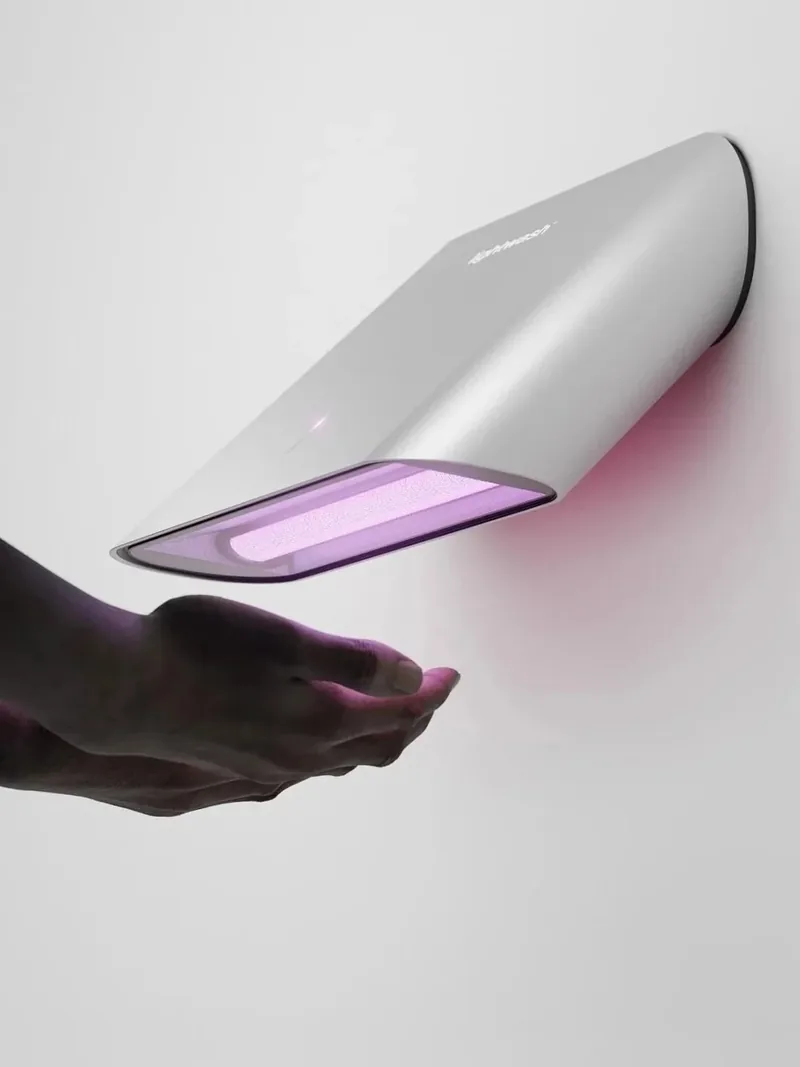
06The source
A clean source of light.
Far-UVC at 222 nm is produced by filtered krypton-chloride excimer lamps. Unlike the low-pressure mercury lamps used for 254 nm, they contain no mercury. Filtering removes longer wavelengths that would reach living tissue.
- Peak wavelength
- 222 nm
- Exposure
- Within ICNIRP limits
- Lamp life
- 8,000–10,000 h
- Mercury
- None
- Consumables
- None
References
Sources.
- Buonanno M, et al. Germicidal efficacy and mammalian skin safety of 222-nm UV light. Radiation Research 2017;187(4):493–501.
- Buonanno M, et al. Far-UVC light (222 nm) efficiently and safely inactivates airborne human coronaviruses. Scientific Reports 2020;10:10285.
- Welch D, et al. Far-UVC light: a new tool to control the spread of airborne-mediated microbial diseases. Scientific Reports 2018;8:2752.
- Far-UVC reduction of aerosolized murine norovirus in an occupied room, with benchtop D90 values for MNV, H1N1 and OC43. Scientific Reports 2024. doi:10.1038/s41598-024-57441-z.
- Antiviral effect of 222 nm far-UVC light against human coronavirus and rhinovirus, and murine norovirus using dried inocula. Infection Prevention in Practice 2025. doi:10.1016/j.infpip.2025.100473.
- Jones JP, Norton K. 222-nm ultraviolet light inactivates dried inocula of human rhinovirus and human coronavirus on a glass carrier. Journal of Hospital Infection 2021;117.
- Far-UVC light (222 nm) efficiently inactivates clinically significant antibiotic-resistant bacteria on diverse material surfaces. Microbiology Spectrum 2024. doi:10.1128/spectrum.04251-23.
- Hessling M, et al. Far-UVC radiation for disinfecting hands or gloves? Pathogens 2023;12(2):213.
- Narita K, et al. 222-nm UVC inactivates a wide spectrum of microbial pathogens. Journal of Hospital Infection 2020. doi:10.1016/j.jhin.2020.03.030.
- Nerandzic MM, et al. Evaluation of a hand-held far-ultraviolet radiation device for decontamination of Clostridium difficile and other healthcare-associated pathogens. BMC Infectious Diseases 2012.
- Efficacy of a far-ultraviolet-C light technology for continuous decontamination of air and surfaces. Infection Control & Hospital Epidemiology 2023.
- Efficacy of three commonly used hand disinfectants according to EN 1500 and EN 14476. Antimicrobial Resistance & Infection Control 2013;2:19.
- ACGIH. 2022 Threshold Limit Values for ultraviolet radiation. 222 nm: 160 mJ/cm² (eye), 480 mJ/cm² (skin).
- Jabbar U, et al. Effectiveness of alcohol-based hand rubs for removal of Clostridium difficile spores from hands. Infection Control & Hospital Epidemiology 2010.
- Stahmeyer JT, et al. Hand hygiene in intensive care units: a matter of time? Journal of Hospital Infection 2017. Mean observed rub time 7.6 s.
- Nursing preference for alcohol-based hand rub volume. Infection Control & Hospital Epidemiology. 53 nurses, 140 shifts: mean dose 1.09 mL.
- Voniatis C, et al. Evidence-based hand hygiene: liquid or gel handrub, does it matter? Antimicrobial Resistance & Infection Control 2023;12:12.
- Hand hygiene technique of 705 clinicians in routine practice, Extremadura, Spain. American Journal of Infection Control 2015.